
Our modern world has become a thicket of complexity: towering steel canyons, labyrinthine machinery, oceans filled with drifting debris. We have built a civilization of astonishing density, yet our sensory technology remains tragically fragile. Sonar, radar, lidar, these tools blink and stutter when the world becomes too crowded. They drown in their own reflections, lose themselves in echo storms, collapse under the weight of noise.
In the maze, our machines go blind.

But the key to solving this blindness does not lie in faster processors or brighter beams. It lies in a creature so ancient and unassuming that we often overlook the genius hiding in its wings. The bat, master of darkness, sovereign of the echo, has already solved the problem we struggle with. For millions of years it has navigated impossible spaces with elegance, mapping the night with a precision no silicon sensor has ever matched.
If we want a revolution, we must learn from the night-flyer.
If we want clarity, we must decode the Mimétique Code: the blueprint of an intelligent listener.
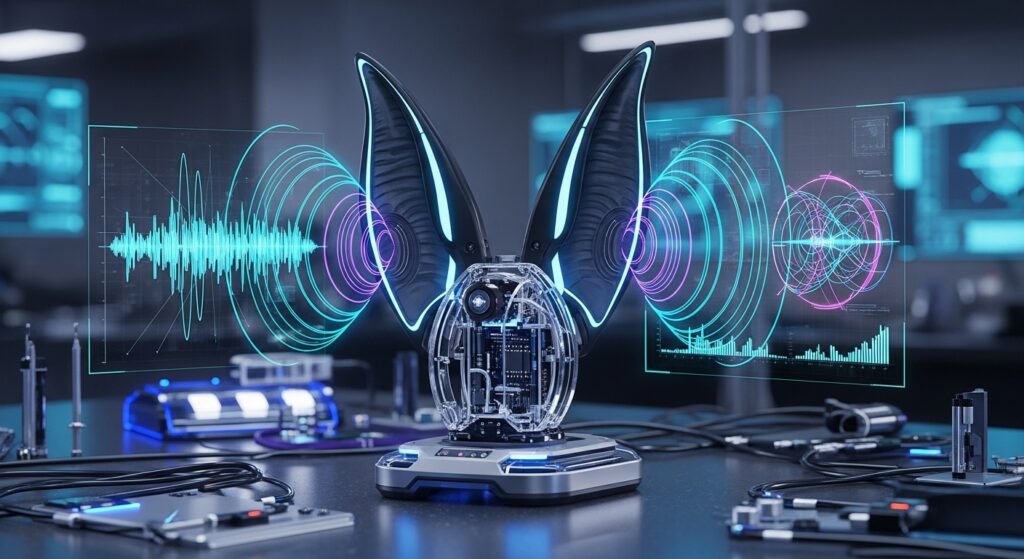
Decoding the soundscape
Our sonar can measure distance, yes. But distance alone is a primitive metric: flat, simplistic, easily disrupted by clutter. In the tightest, most complex spaces, our systems falter.
Yet in those same conditions, nature performs miracles.
A bat hunts in darkness so complete that light is irrelevant. And still, it snatches a mosquito: mid-flight, mid-spin, mid-chaos.
The Mimétique Code exposes the secret: bats do not measure echoes; they compose them. They sculpt sound. They craft highly directional calls tuned to reveal different textures of the world. Their ears, flexible, intricate, alive, shift and rotate to capture the returning echoes with exquisite nuance.
To the bat, a tangled forest is not a wall of noise.
It is a symphony of shapes.
A precise acoustic map.
A world rendered in sound.
The gulf between our technology and this natural mastery is immense.
We measure.
The bat understands.
Where we see clutter, it sees clarity.
The rise of the bio-acoustic sensor
Now, scientists are peeling back the layers of this biological brilliance. They are translating anatomy into engineering, instinct into algorithm. And the results are rewriting the future of sensing.
The innovation is audacious:
- New sonar systems that echo the bat’s multi-frequency calls: complex, layered, information rich.
- Robotic ears that physically reshape themselves in real time, focusing in on meaningful echoes, rejecting noise, sharpening perception.
- Dynamic sensors that do not passively receive the world, but actively interrogate it.
The first prototypes are already astonishing. They outperform the old linear systems. They classify objects with unprecedented accuracy. Also, they recognize patterns that used to vanish in static noise.
The machine is no longer merely detecting.
It is listening and with intent.

Zero-blind-spot technology
The future of sensing will not be dominated by light alone.
It will be built on intelligent listening: fluid, adaptive, alive.
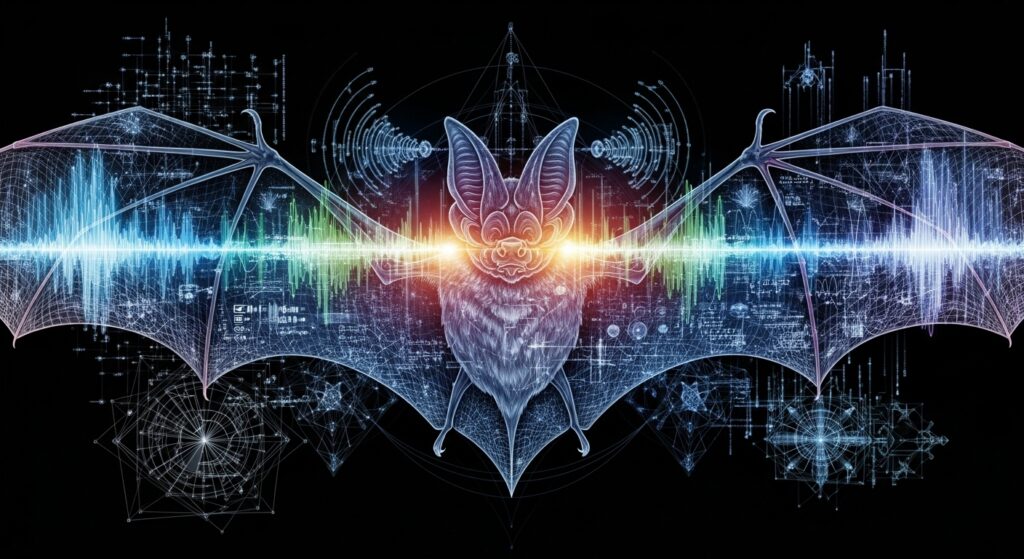
The Bat’s Ear Protocol points the way forward across industries that cannot afford blind spots:
Autonomous Navigation
Drones weaving through urban corridors with confidence, no longer tricked by concrete reflections or tangled structures.
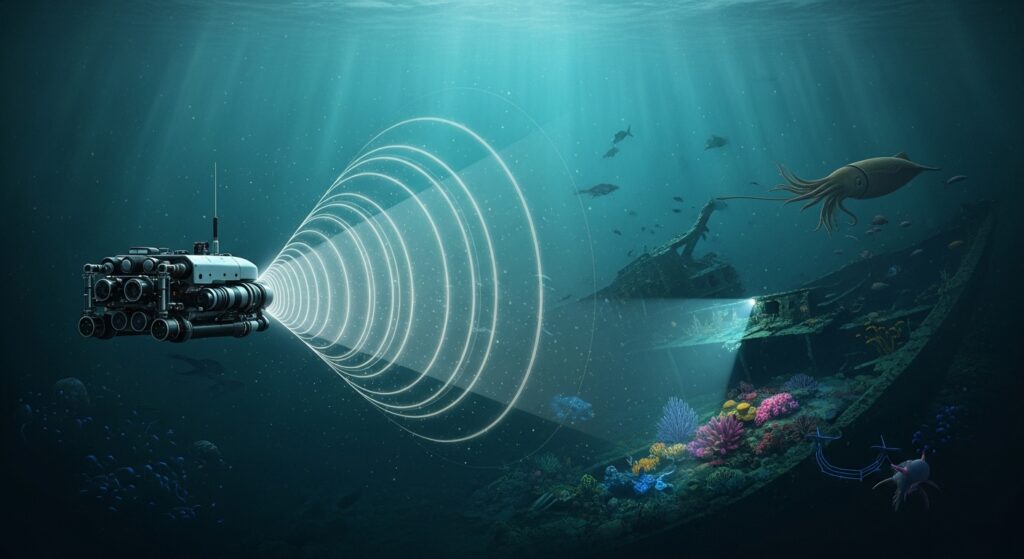
Deep-Sea Exploration
Sensors that cut through murky, lightless waters, mapping landscapes where cameras and lasers fail.
Medical Imaging
High-resolution, non-invasive diagnostics that reveal details traditional systems blur or miss entirely.
Static sensors are relics. Passive surfaces are remnants of an older technological age.
The bat has handed us the final piece of the puzzle:
True accuracy demands dynamic, bio-acoustic intelligence.

We now stand at the threshold of a new era: one where machines no longer see like cameras, but listen like living creatures. And in that shift lies the promise of a world without blind spots.
Leave a Reply