
The adhesion failure: the impossible trade-off 🕸️
The Problem
When it comes to adhesives, we currently face an impossible choice. You get something that can stick, even your fingers! or you get sustainability, but you almost never can find both.
And the typical chemical adhesives we rely on? They are fundamentally flawed! They are rigid, meaning they seem to often fail outright whenever temperatures or humidity changes. Crucially, they leave a toxic trail behind them because they have non-recyclable residue that permanently destroys the materials they were meant to join. It’s not ideal, leading to a bio-adhesive replication failure issue, which is problematic.
The spider’s mastery
Now, the Orb Weaver spider has achieved something quite amazing. It seems to completely solve that “impossible” adhesion problem. How? The unique glue coating its capture silk is simply incredible.
It is identified as being stronger than many commercial glues and instantly sticky. It is also entirely non-toxic and biodegradable. But here is the critical breakthrough, the reason it is worth exploring it deeper: this glue works perfectly even in high humidity, without the risk of bio-adhesive failure you might expect.
The mimétique code: the hygroscopic secret
Now we get to the core secret! This is what we call The Mimétique Code or perhaps more simply the hygroscopic Secret!
What is the mechanism? Biologically speaking, the spider’s adhesive is actually just a tiny microscopic droplet. This droplet is complex, built from specialized glycoproteins mixed with a complex blend of LMMCs (those are the Low Molecular Mass Organic and Inorganic Compounds).
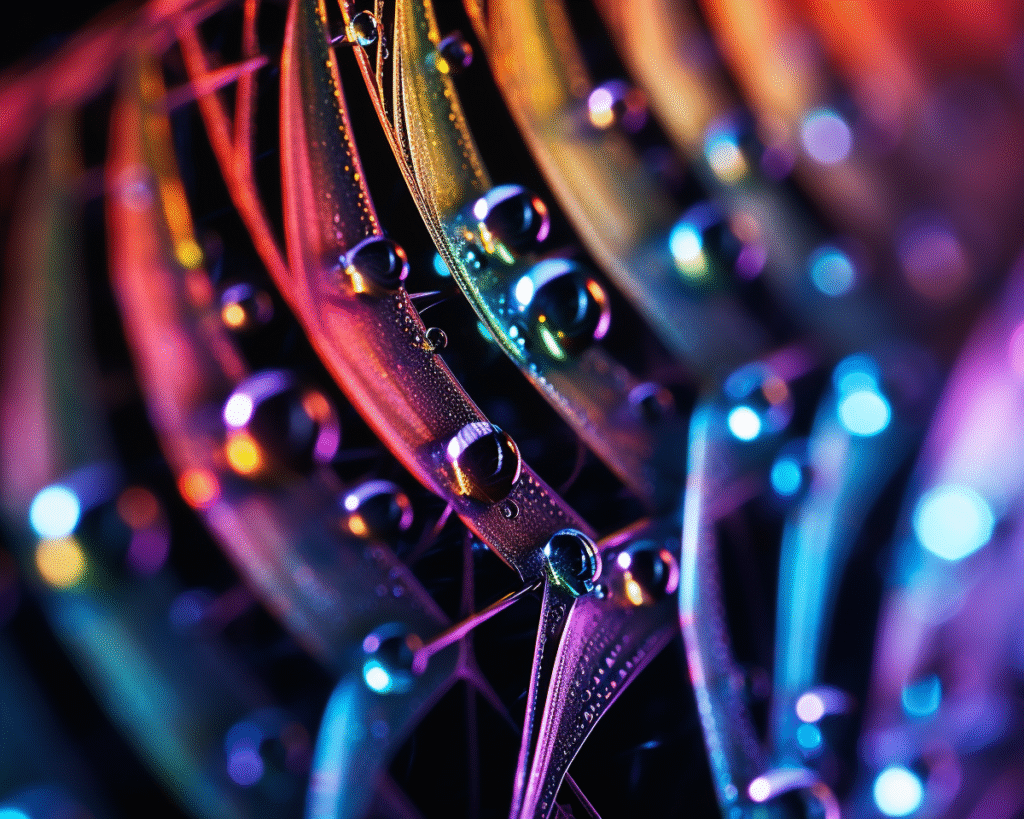
The key insight that changes everything: these LMMCs are hygroscopic. That means that their mission is to aggressively attract and absorb water.
Crucially, they pull the water away from the interface, as in the precise spot where the glue needs to make contact with the object. By managing the moisture this way, the protein component can form adhesive bonds instantly, reducing chances of replication failure.
Essentially, the spider completely bypasses the dreaded “interfacial water” problem. That interfacial water challenge seems to be exactly what causes nearly all human-made glues to fail the moment conditions become wet.
A new Bio-Synthesis mandate
This is where we jump from biology into the future of materials! Industrial replication is a massive undertaking because the natural process is incredibly complex. But while the challenge is strategic, the principles for success are don’t seem impossible.
First, we need the materials. We can’t synthesize these complex components chemically. Instead, we have to leverage synthetic biology. This means that we must use organisms, for instance we could imagine some form of bacteria or yeast, to produce those complex silk proteins and glycoproteins. These organisms could become our bio-factories for the glue’s building blocks.
Second, we need to master that wet bond. The crucial engineering key seems to be water management. We absolutely must think of a way to engineer our synthetic glue to contain that hygroscopic, water-managing-like component. For that, we need to guarantee that the bond is formed on a dry surface, even if the environment around it is completely wet. This management could prevent replication failures in bio-adhesives.

The future will need to look into the adhesion mechanism itself, because it seems replicating the fiber has been explored quite a lot. If we could crack the code, this innovation could unlock breakthroughs in so many fields!
Disclaimer: This content is for informational and educational purposes only and reflects conceptual analysis, not professional engineering or financial advice.
The Mimétique Code in Motion: Watch our deep dive into the cracking the spider code strategic brief, now visualized by Notebook LM.
References
- Spider Glue Mechanism: Role of Hygroscopic Low Molecular Mass Compounds in Humidity Responsive Adhesion of Spider’s Capture Silk, Dharamdeep Jain, Gaurav Amarpuri, Jordan Fitch, Todd. A. Blackledge, and Ali Dhinojwala Biomacromolecules 2018 19 (7), 3048-3057
- Protein Synthesis: Trossmann VT, Scheibel T. Design of Recombinant Spider Silk Proteins for Cell Type Specific Binding. Adv Healthc Mater. 2023 Apr;12(9):e2202660. doi: 10.1002/adhm.202202660. Epub 2023 Jan 13. PMID: 36565209; PMCID: PMC11468868.
- Brent D. Opell, Dharamdeep Jain, Ali Dhinojwala, Todd A. Blackledge; Tuning orb spider glycoprotein glue performance to habitat humidity. J Exp Biol 15 March 2018; 221 (6): jeb161539.
- Bio-Adhesives Market: Bioadhesives Market (2024 – 2030) Size, Share & Trends Analysis Report By Source (Plant-based, Animal-based), By End Use (Packaging & Paper, Construction, Personal Care & Cosmetics), By Region, And Segment Forecasts.
- Scaling & Production: Rising A, Widhe M, Johansson J, Hedhammar M. Spider silk proteins: recent advances in recombinant production, structure-function relationships and biomedical applications. Cell Mol Life Sci. 2011 Jan;68(2):169-84. doi: 10.1007/s00018-010-0462-z. Epub 2010 Jul 29.
- Design for Disassembly: Science Direct link
- Here’s an overview of the challenges and benefits of harvesting spider silk for everyday use: Harvesting Spider Silk for Everyday Use. This video provides an engaging demonstration and discussion of the strength and potential applications of the super strong glue made from spider protein.
Leave a Reply