
The flaw of the anthropocentric machine
Do you know the true, underlying reason for our repeated failures? Why our most meticulously engineered automatons still falter at the threshold of the real world? It is a profound, almost tragic design flaw, a clinging to the very arrogance that necessitated their creation.
We have burdened them with the anthropocentric machine.
And we insist on forcing heavy, rigid, human-invented mechanics onto a form that demands fluidity. We design with joints and hinges where nature uses cartilage and flow. Consequently, our best attempts are stiff, monstrously power-hungry, and utterly brittle. They move from the sterile, predictable laboratory floor and shatter the moment they encounter the sublime, beautiful chaos of the true environment. For instance, the jagged rock, the shifting mud, the unpredictable gust.
This era must end.
The Mimétique Code is our testament to this reckoning. It is a whisper of undeniable truth: the ultimate, resilient, enduring robot must, at its core, be a biological system. Nature, across four billion years of iterative, unforgiving refinement, has already solved every single engineering challenge we currently face. This is the case for compliance, efficiency, power, and graceful failure.

Our task is not to invent a new lever or a better engine. Our task is to surrender the ego of the human designer and to finally, faithfully translate nature’s blueprint into a usable code.
Power and endurance: the zero-waste Core
A climate robot must run clean. It needs huge endurance, but it cannot create pollution.
Look closely at a leaf. What you witness is not mere botany, but a profound, silent miracle. Nature achieves an energy density that has long humbled our finest engineers. This, with only carbon dioxide, water, and the ceaseless gift of sunlight, . It is an ancient, elegant formula, the ultimate power source built from the very breath of the planet.
This organic blueprint became our obsession. We didn’t seek to merely imitate the leaf; we sought to capture its essential genius. Our answer is the Eco-Sentinel’s Bio-Synthetic Skin. It is a sophisticated membrane that drinks in light, perfectly mimicking the photosynthetic pigments of its botanical muse. Yet, this is only half the equation. The captured carbon is channeled into a closed-loop power cell, the engine of the machine. It runs purely on bio-methanol derived from the very CO2 it captures.
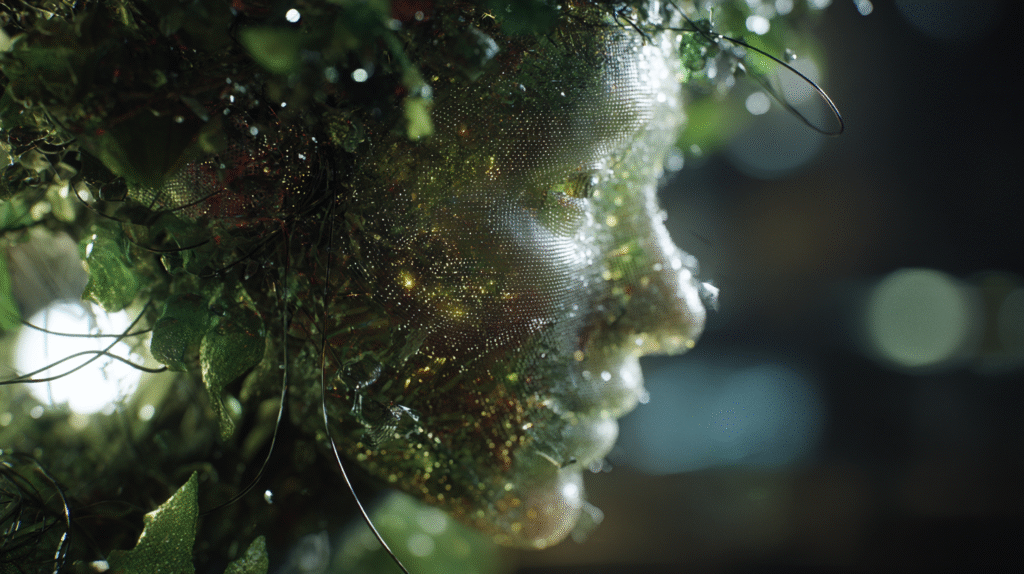
The result is a liberation from the tyranny of the grid. Our robot operates entirely outside the fossil fuel economy. It does not merely conserve energy, nor does it offset its carbon. It literally fuels itself by cleaning the air. The Eco-Sentinel is a self-sustaining promise, a machine that thrives only when it regenerates its environment.
Delicate intervention
The irony is stark, the mandate clear: we send steel and wire to save what steel and wire have already scarred. In the fragile theatres of crisis, the collapsing coastal wetlands, the soil made quicksand by thaw, a heavy, rigid robot is not a savior, but simply the next wave of destruction. To tread is to destroy.
I. The Biological Mandate: A Lesson in Lightness
We turn our gaze from the forge to the pond, seeking a better calculus of contact. The models are ancient, perfected: the Water Strider, which dances on surface tension as if gravity were a rumor; the Arachno-Jump system, translating minimal ground force into a burst of maximal, efficient power. They teach us the Sovereignty of Lightness: movement achieved with grace, not mass.
II. The Mimétique Solution: Engineering by Empathy
Our answer is to unburden the machine, to dissolve the motor. We replace the heavy iron heart of electricity with the fluidity of life itself, building Soft Actuators: lightweight, silent, fluid-driven joints. And where a boot would crush, we fit geodesic, multi-jointed feet, engineered to distribute weight with the minimal, sublime pressure of a water strider’s step.
III. The Outcome: Non-Invasive Locomotion
This is not just robotics; it is ecological fidelity. The machine, finally, becomes a respectful guest. The outcome is Non-Invasive Locomotion: a robot that can traverse the root system of a marsh, the crust of a frozen earth, or the delicate structures of a coral garden, leaving no trace, causing no vibration, and achieving its critical mission without disturbing a single grain of soil. It walks not upon the environment, but with it.
The gentle art of respiration: a narrative on manipulation
The mandate was a paradox: to be gentle enough to birth a future, yet capable of cleansing a ruined past. We sought a hand that could cradle a nascent life, a seedling barely strong enough to break the soil, while simultaneously performing the brutal, advanced work of planetary filtration.
Our engineers looked past the realm of steel and servo motors, turning instead to the biological mandate. We found our truth not in a forge, but in the brine. The Octopus Arm became our muse for compliant strength, a boneless, intelligent ribbon of muscle and nerve, capable of both a crushing embrace and a feather-light caress. For the second, more vital function, we studied the Mangrove Root; that silent, splayed architecture that draws nourishment from the brackish mess, filtering the toxic from the true.
The Mimétique Solution was born from this pairing. We clothed the robot’s manipulators not in alloy, but in soft pneumatic grippers, devices of hyper-compliance that inflate and deflate with a breath-like rhythm, the true embodiment of the Octopus Arm concept. These weren’t clumsy clamps; they were hands that understood pressure, contour, and fragility.
But the true genius lay in the skin.
Crucially, woven directly into the synthetic palm surfaces, right where the gentle grip was applied, were micro-filtration pores. They were a thousand tiny, hungry mouths, modeled after the root’s cellular structure. This was the Mangrove Root model brought to the air. The grip that tended the sapling was also, passively, and without a second command, scrubbing CO2 from the immediate, polluted air around it.
The Outcome was a single, elegant act: Habitat Restoration and Air Scrubbing. The robot would wade into the ruined wetlands or the scorched earth, its movements slow, deliberate, and impossibly kind, planting a living thing with a touch that would not bruise, while its very contact with the environment performed the essential, silent work of respiration—inhaling the poison so the planet might finally exhale.

The living veil: a narrative on sensation and adaptability
A proxy built to mend the climate must first be a perfect witness. It was not enough for the automaton to perform labor; it had to feel the pulse of the environment in a continuous, unwavering stream. It required an awareness that bordered on intuition, a capacity to monitor the planet’s health in real-time.
We turned, once again, to the biological mandate, finding the perfect architecture of sensation in the most familiar place: Human Skin. It is not mere covering; it is the ultimate, massive sensor array, an unbroken sheet of data collection, registering the finest shift in pressure, temperature, and environmental chemistry. To touch is to know.
The challenge was to translate this organic intimacy into a synthetic form.
Our Mimétique Solution was the creation of the Electronic Skin, or E-Skin. We didn’t outfit the robot with clumsy, discrete monitors, but rather draped it in a continuous, soft, and flexible synthetic epidermis. This veil was laced with countless micro-sensor arrays, an invisible lattice that spanned the entire body. Every brush of air, every subtle change in the heat of the soil, every shift in the atmosphere became a quantifiable input.

The Outcome transformed the robot from a mere machine into a highly capable sensor platform. As it moved, it didn’t just plant and filter; it was perpetually mapping a digital soul of the landscape. Every step reported the soil moisture level, every passing breeze transmitted the precise air temperature, and every subtle shift in the environment informed on the local CO2 concentration. This was not generalized data; it was actionable, fine-grained intelligence, transmitted instantly back to the human minds waiting to analyze the planet’s precise, minute-by-minute suffering and recovery.
The robot didn’t just work; it felt, making its movements less an operation and more a form of sympathetic exploration.
The enduring whisper: a narrative on the biomechatronic mandate
And so we arrive at the threshold of the future, embodied by this construct, the Eco-Sentinel. It is not merely a product of engineering; it is the ultimate, living articulation of the Mimétique Code.
The mandate is now crystalline: we must abandon the rigid, polluting idols of the previous age. The machine of iron and oil, the clanking, deafening monument to brute force, has failed the Earth. Its carbon exhaust is the shadow that darkens our sky.
The Sentinel, in its quiet, compliant grace, with its soft, filtering hand and its sensing, empathetic skin, proves that a superior path exists. It shows that true innovation lies not in overpowering nature, but in imitating its patience and efficiency.
This is more than a design choice; it is a philosophy. It is the call to invest, wholly and without reservation, in this holistic approach. Every facet of this guardian, from its fundamental structure to its very breath, is aligned with the planet’s survival. Its ultimate promise rests upon a foundational purity: the commitment to a zero-carbon power source, ensuring the servant tasked with healing does not, in its operation, inflict further injury.
The Eco-Sentinel is the tangible proof that biomechatronics is not a specialized field, but the inevitable language of sustainability. It is a profound shift: the end of the mechanical age, and the quiet dawn of the age of the symbiotic machine.

Disclaimer: This content is for informational and educational purposes only and reflects conceptual analysis, not professional engineering or financial advice.
Leave a Reply